Feature
Accurate & fast PDF quote parsing
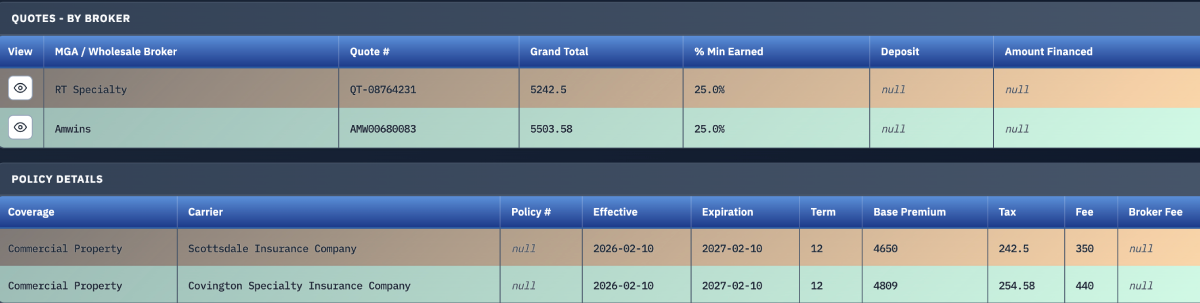
Multi-pass extraction pulls the carrier, premium, limits, and coverage details out of quote PDFs — whether they're clean digital documents or scanned images — no matter what format the market sends.
The problem it solves
Every wholesaler, MGA, and carrier formats their quotes differently — different layouts, different section ordering, different terminology for the same concept, and sometimes a scanned image instead of a real digital PDF. There's no standard place to look for the premium, the limits, or the retention; each document has to be read and interpreted before a single number can be used. Doing that by hand and retyping the figures into a spreadsheet or the AMS is slow, and it's the exact point where transcription errors creep in — a transposed limit or a dropped endorsement that survives every casual review until a claim.
In admitted lines, structured data flows through rating engines. Surplus lines has no such luxury: the quote is a PDF, and the data you need is trapped inside it. Getting it out reliably, across every format your markets use, is the crux of the whole intake problem.
How it works
A multi-pass approach handles the variety. It reads clean digital PDFs directly, and falls back to optical character recognition (OCR) for scans and image-based documents. It then locates the fields that matter regardless of where they sit on the page, rather than relying on a fixed template for each carrier.
- Digital and scanned PDFs are both supported, so a faxed-then-scanned quote works as well as a native one.
- Format-agnostic — not locked to a short list of known carrier templates, which matters when a new market sends a layout you've never seen.
- Key fields captured — carrier, premium, limits and sublimits, retentions, and coverages — as structured data.
- Structured output that flows straight into quote comparison and into your AMS.
The result is that a quote stops being a document you have to read and becomes data you can use. Once extracted, the same figures carry through the rest of the workflow — you never retype them again.
Accuracy and why it compounds
Accurate extraction isn't just a convenience; it's a risk control. Because the data is captured once and carried forward, the numbers you compare are the numbers the carrier actually sent, and the numbers you bind on are the same again — not a hand-copied approximation that drifted a little at each step. Every manual retype you remove is an opportunity for an errors-and-omissions mistake removed with it. We cover that connection in depth in reducing E&O exposure from manual AMS data entry.
Why it matters
This is the step that removes the most retyping in the entire submission-to-bind workflow. Data captured once, accurately, carries forward through comparison and into bind — saving hours per submission and cutting the errors that create liability. It's the difference between a quote intake process that scales with volume and one that needs another set of hands every time the book grows.
Frequently asked questions
Can it read scanned quote PDFs, or only digital ones?
Both. It reads clean digital PDFs directly and falls back to OCR for scanned or image-based documents, so quotes work regardless of how the market produced them.
Does it only work with certain carriers' formats?
No. Extraction is format-agnostic — it locates the fields that matter wherever they sit on the page, rather than being tied to a short list of known templates.
What data does it pull from a quote?
The key fields you compare and bind on — carrier, premium, limits and sublimits, retentions, and coverages — as structured data that flows into comparison and your AMS without retyping.
Test it on your carrier formats
Bring a few real quote PDFs and we'll parse them live. 20 minutes, no pressure.
Request a Demo