Feature
Kanban submission workflow
A visual pipeline that tracks every insured from submission through bind and into next year's renewal — so nothing stalls, and nothing slips through the cracks.
The problem it solves
Most agencies track surplus lines submissions in their head, a shared spreadsheet, or a cluttered inbox. That works until volume climbs — then simple questions get hard to answer: What's still out to market? What's been quoted but not bound? Which broker is sitting on a response? What renewal is sneaking up next month? Because the status of each deal lives in too many places at once, work stalls silently and nobody notices until an insured calls or an effective date slips past.
The cost isn't just the occasional missed renewal. It's the constant low-grade drag of reconstructing status — a producer asking an assistant where an account stands, an assistant digging through email to answer, a principal with no real-time picture of the book. In excess and surplus (E&S) especially, where a single submission can be out to several markets with responses trickling in over days, that fog compounds fast.
How it works
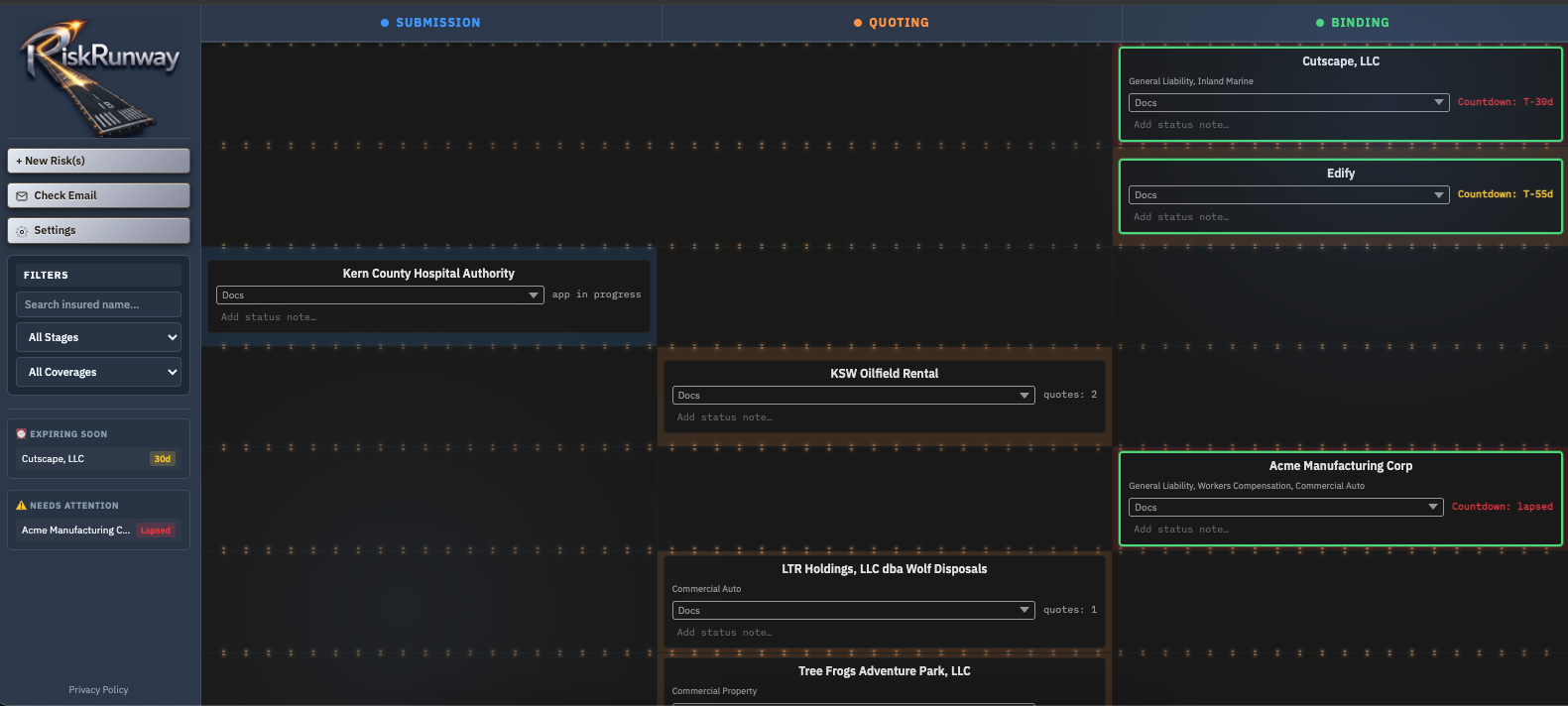
Each insured is a card on a board, and the card moves through the stages of your real quote-to-bind process — submitted to market, quotes received, gathering documents, ready to bind, and bound. The layout mirrors how the work actually flows, so a glance at the board answers "where does everything stand?" without asking anyone for an update.
- Visual stages mirror your real quote-to-bind process, so the board matches how your team already thinks about the pipeline.
- Cards carry context — the insured, the markets it's out to, the quotes received, and the documents attached — so opening one shows the full picture of that deal.
- Renewal cycling carries bound business forward as a renewal so expirations surface early, with the prior placement attached as a reference.
- At-a-glance status replaces the mental math and scattered spreadsheets most teams rely on today.
Because the board is fed by the rest of the platform, cards update as work happens elsewhere. When a broker quote lands in the inbox, the card reflects it; when documents are captured, they attach to the right deal. The pipeline stays current without anyone maintaining it by hand.
Who it's for
Any agency placing commercial or surplus lines business benefits, but the value scales with volume and team size. A solo producer gets a reliable memory that never drops a submission. A larger team gets a shared source of truth, so producers, account managers, and principals all see the same status without a status meeting. Agencies with a meaningful renewal book get the most protection against the quiet revenue leak of an expiration that slipped by.
Why it matters
When the whole pipeline is visible, stalled submissions and upcoming renewals stop falling through the cracks, and the team spends less time reconstructing status and more time moving deals toward bind. Visibility is also the foundation for everything else: you can't improve a workflow you can't see. A clear board turns a reactive, "what did I forget?" process into a proactive one where the next action on every account is obvious.
Frequently asked questions
What is a kanban workflow for insurance submissions?
It represents each insured or submission as a card that moves through the stages of your quote-to-bind process — submitted, quoted, gathering documents, ready to bind, bound. It gives you one visual view of where every deal stands, instead of checking multiple spreadsheets and inboxes.
How does it help with surplus lines renewals?
The board tracks upcoming expirations and cycles bound business forward as a renewal, carrying the prior placement along as a reference. Renewals surface early, so you have time to remarket rather than scrambling near the effective date.
Does the kanban board replace our agency management system?
No. It manages the pre-bind pipeline and then pushes finalized data into your AMS, which stays the system of record.
See the pipeline on your book
We'll walk through how the board maps to your actual submission process. 20 minutes, no pressure.
Request a Demo